
50+ Common Web Application Vulnerabilities Explained

Modern organizations increasingly rely on cloud-based platforms to deliver seamless digital experiences. While this improves agility and scalability, it also increases exposure to cyber threats. Even a single web application vulnerability can lead to data breaches, operational disruption, and loss of customer trust.
Attackers actively exploit weaknesses in access control, authentication, APIs, and outdated components, making web application security vulnerabilities a leading cause of incidents across industries. Understanding these risks is essential for building a proactive defense strategy.
This guide covers 50+ of the most common vulnerabilities found in modern web applications, helping organizations reduce security risks, align with OWASP web application vulnerabilities best practices, and improve outcomes through effective web app testing.
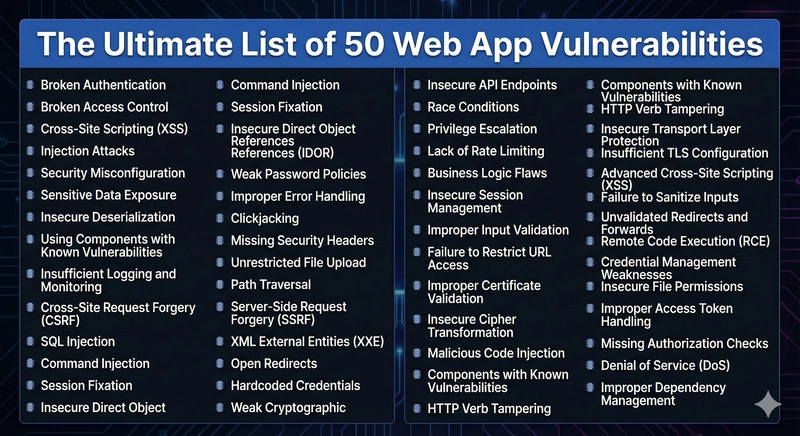
The Ultimate List of 50+ Web App Vulnerabilities
Understanding web application vulnerabilities is crucial for developers, testers, and security teams to protect sensitive data and maintain robust security. Below is a comprehensive list of 50 common vulnerabilities that you should be aware of.
1. Broken Authentication
Broken authentication is a critical web application vulnerability that occurs when applications fail to properly verify user identities. This usually happens due to weak password policies, poor session management, or insecure handling of authentication tokens.
Attackers exploit broken authentication by stealing credentials, guessing passwords, or hijacking active sessions. Once successful, they can impersonate legitimate users and gain unauthorized access to sensitive systems. This issue is widely recognized among common web application vulnerabilities because it directly affects user trust and data protection.
To reduce exposure, organizations must enforce strong authentication mechanisms, protect session identifiers, and regularly review login workflows as part of a structured web application vulnerability assessment.
2. Security Misconfiguration
Security misconfiguration is a widely exploited web application vulnerability that occurs when default or incomplete security settings are left unchanged. This includes using default credentials, exposing unnecessary services, enabling verbose error messages, or running outdated software components.
Attackers actively scan for misconfigured servers and applications because these weaknesses are easy entry points. Poor configuration management significantly increases web app security risks, especially in cloud and containerized environments where rapid deployments often skip proper hardening steps.
Among web application security vulnerabilities, misconfiguration is one of the most preventable issues. Regular configuration reviews, automated security checks, and consistent patch management play a key role in reducing exposure during a web application vulnerability assessment.
3. Cross-Site Scripting (XSS)
Cross-site scripting is a common web application vulnerability that allows attackers to inject malicious scripts into trusted web pages. These scripts execute in a user’s browser and can steal session data, redirect users to malicious sites, or manipulate page content without the user’s knowledge.
XSS typically occurs when applications accept user input without proper validation or output encoding. Because it directly targets end users, it remains one of the most dangerous common web application vulnerabilities, especially in applications that handle dynamic content or user-generated data.
Mitigating XSS requires strict input validation, context-aware output encoding, and secure development practices. Identifying such flaws early helps organizations minimize web app security risks and improve overall application resilience.
4. Insecure Direct Object References (IDOR)
IDOR occurs when an application exposes internal object references, such as database IDs or file names, in URLs or requests without proper authorization checks. Attackers can simply modify these values to access data belonging to other users.
This web application vulnerability is especially risky in applications that rely heavily on predictable identifiers. Preventing IDOR requires enforcing access checks on every request, not just during login, which significantly lowers real-world misuse.
5. Cross-Site Request Forgery (CSRF)
CSRF tricks authenticated users into performing unwanted actions without their knowledge, such as changing account details or initiating transactions. The attacker relies on the user’s active session to execute the request.
Because it abuses trust rather than technical flaws alone, CSRF remains one of the more deceptive common web application vulnerabilities. Implementing anti-CSRF tokens and validating request origins helps reduce this risk effectively.
6. Components with Known Vulnerabilities
Modern applications depend on third-party libraries, frameworks, and plugins. When these components are outdated or unpatched, attackers can exploit publicly known flaws to compromise the entire application.
This issue is a persistent web application vulnerability because organizations often lose track of dependencies. Regular updates, dependency scanning, and inventory tracking are essential to reduce exposure and long-term web app security risks.
7. Directory Traversal
Directory traversal allows attackers to access files and folders outside the intended application directory. By manipulating file paths in a request, they can reach sensitive system files that were never meant to be exposed through the application.
This issue becomes serious when input validation is weak and file access rules are poorly enforced. Preventing directory traversal mainly involves sanitizing user inputs and restricting file system access at the server level.
8. Insecure Deserialization
Insecure deserialization happens when an application accepts serialized data from untrusted sources and processes it without proper validation. Attackers can modify this data to alter application logic or execute unauthorized actions.
Because deserialization flaws can lead to severe outcomes like remote code execution, they are considered a high-risk web application vulnerability. Using safe serialization formats and validating data before processing helps reduce this risk.
9. Insufficient Logging and Monitoring
When applications fail to log critical events such as login attempts, errors, or suspicious activities, attackers can operate without detection. Insufficient logging makes it difficult to identify breaches or respond quickly.
Proper monitoring helps teams detect abnormal behavior early and limit damage. Strong logging practices play an important role in reducing long-term web app security risks and improving incident response.
10. SQL Injection
SQL injection occurs when an application allows unvalidated user input to interact directly with a database query. Attackers exploit this by manipulating inputs to read, modify, or delete sensitive data stored in the database.
This web application vulnerability is still common because many applications fail to use prepared statements or proper input filtering. Preventing SQL injection requires parameterized queries and strict validation of all user-supplied data.
11. Sensitive Data Exposure
Sensitive data exposure happens when applications fail to properly protect confidential information such as passwords, financial details, or personal records. This often results from weak encryption, improper storage, or insecure data transmission.
Among common web application vulnerabilities, this issue can have long-term consequences for both users and organizations. Using strong encryption standards and securing data in transit and at rest helps minimize damage.
12. Unvalidated Redirects and Forwards
Unvalidated redirects occur when applications redirect users to external URLs without proper validation. Attackers can abuse this behavior to trick users into visiting malicious websites that appear legitimate.
Although often overlooked, this flaw increases web app security risks, especially in applications with multiple redirect paths. Validating destination URLs and limiting redirects to trusted domains are effective preventive measures.
13. Cross-Origin Resource Sharing (CORS) Misconfiguration
CORS misconfiguration occurs when a web application allows unrestricted access to resources from untrusted domains. This happens when the “Access-Control-Allow-Origin” header is set too broadly or incorrectly.
Example:
A web app that shares sensitive user data with any domain () can be exploited by attackers to steal information via a malicious website.
**Prevention*:
- Restrict allowed origins to trusted domains only
- Avoid wildcard (*) in production
- Use strict rules for headers and methods
- CORS misconfigurations are a subtle but serious web application vulnerability, increasing the risk of data leaks and unauthorized access.
14. Remote Code Execution (RCE)
Remote code execution allows attackers to run arbitrary code on a server. This occurs when user inputs are not properly validated or sanitized before execution.
Example:
An attacker uploads a file containing malicious scripts to a web app that executes server-side code, giving full control over the server.
Preventing RCE requires:
- Validating all inputs rigorously
- Avoiding execution of untrusted data
- Applying patches promptly
RCE is considered a high-severity web application vulnerability because it can compromise the entire system.
15. HTTP Verb Tampering
HTTP verb tampering happens when attackers manipulate HTTP methods (GET, POST, PUT, DELETE) to bypass security controls or access restricted resources.
Example:
A web app allows only POST requests for updating user profiles. If the server improperly handles GET or PUT requests, attackers may modify data without authorization.
Mitigation strategies:
- Validate allowed HTTP methods on the server
- Implement strict access control for each verb
- Test APIs during a web application vulnerability assessment
This flaw is one of the more technical common web application vulnerabilities but can have serious consequences if ignored.
16. Cross-Site Request Forgery (CSRF)
CSRF tricks authenticated users into performing unintended actions on a web application, such as changing account details or making transactions. The attack relies on the user’s active session to execute the request.
Key Prevention Measures:
- Implement anti-CSRF tokens
- Validate request origins
- Avoid relying solely on session cookies
CSRF remains a common web application vulnerability, particularly in applications that rely on browser sessions without additional validation.
17. Insecure Cryptographic Storage
Insecure cryptographic storage occurs when sensitive data, like passwords or personal details, is stored without proper encryption or with weak algorithms.
This web application vulnerability can allow attackers to recover confidential information if they gain access to the storage system.
Preventive steps include using strong, industry-standard encryption algorithms and proper key management.
18. Broken Authentication
Broken authentication happens when applications fail to properly verify user identities, often due to weak password policies, session management flaws, or predictable credentials.
Example:
An attacker may hijack a session token to impersonate a user and gain administrative access.
Strong authentication practices, secure session handling, and multi-factor authentication reduce this web app security risk significantly.
19. Directory Indexing
Directory indexing occurs when a web server exposes a list of files within a directory, allowing attackers to explore and access files that shouldn’t be publicly available.
Example:
A web app returning a full directory listing like /uploads/ can reveal configuration files or user documents.
Mitigation involves disabling directory listing on servers and restricting access to sensitive directories. This remains a notable web application vulnerability because it provides attackers with reconnaissance data.
20. Operating System (OS) Command Injection
OS command injection happens when user input is passed to system commands without proper validation. Attackers can execute arbitrary commands, potentially taking full control of the server.
Key Prevention:
- Validate all user inputs
- Avoid using system calls with untrusted data
- Use safe APIs for file and process operations
This is a high-severity web application vulnerability, especially in apps that rely on system-level operations.
21. Session ID Leakage
Session ID leakage arises when session identifiers are exposed in URLs, cookies, or logs, allowing attackers to hijack user sessions.
Example:
A URL like www.example.com/dashboard?sessionid=abc123 can be shared or intercepted, letting attackers impersonate the user.
Preventive measures include using secure cookies, avoiding session IDs in URLs, and implementing proper session expiration.
22. Insecure Deserialization
Insecure deserialization happens when a web application processes serialized data from untrusted sources without verifying its integrity. Attackers can manipulate this data to change application logic, inject malicious content, or even achieve remote code execution.
Why it matters:
- Can lead to full server compromise in severe cases
- Often overlooked in security testing because the data may appear harmless
- Affects applications that exchange complex objects or session data
Mitigation strategies:
- Only accept serialized objects from trusted sources
- Validate and sanitize all incoming data
- Use safe serialization libraries that enforce strict typing
This type of web application vulnerability is critical because it can compromise both server operations and sensitive user information if left unchecked.
23. Insufficient Session Expiration
Insufficient session expiration occurs when applications do not log out inactive users in a timely manner. Attackers can exploit this to hijack sessions, impersonate users, or gain unauthorized access to sensitive data.
Key risks:
- Persistent sessions allow unauthorized access after user leaves the device unattended
- Stolen session tokens can bypass authentication entirely
Prevention measures:
- Implement automatic session timeouts based on inactivity
- Track and invalidate old or duplicate sessions
- Use secure cookie attributes (HttpOnly, Secure) for session identifiers
This web application vulnerability is common in applications that maintain long-lived sessions without monitoring, making it a priority for security assessments.
24. LDAP Injection
LDAP injection arises when applications fail to properly handle user input in Lightweight Directory Access Protocol (LDAP) queries. Attackers can modify these queries to bypass authentication, retrieve confidential user data, or escalate privileges.
Impact:
- Unauthorized access to directory data such as usernames, passwords, or group memberships
- Potential to compromise internal enterprise systems that rely on LDAP authentication
Prevention:
- Validate and sanitize all user inputs before including them in LDAP queries
- Use parameterized queries or prepared statements for LDAP
- Limit permissions for LDAP accounts used by the application
This web application vulnerability is especially critical for enterprise applications that rely on directory services for authentication and authorization. Proper input validation and secure query design are essential to prevent attacks.
25. Cross-Site Scripting (XSS)
Cross-Site Scripting occurs when attackers inject malicious scripts into a web page that is viewed by other users. These scripts can steal session data, manipulate page content, or redirect users to malicious websites.
Why it’s critical:
- Targets end users directly, not just the application
- Can lead to account compromise, phishing, or data theft
Prevention strategies:
- Validate and sanitize all user inputs
- Use context-aware output encoding for HTML, JavaScript, and URL
parameters
Employ Content Security Policy (CSP) headers to restrict script execution
XSS remains one of the most common web application vulnerabilities, particularly in applications handling dynamic or user-generated content. Proper coding practices and security testing can significantly reduce exposure.
26. Security Misconfiguration
Security misconfiguration occurs when applications or servers are left with default settings, unnecessary features enabled, or incomplete security hardening. This can allow attackers to exploit exposed endpoints, default accounts, or verbose error messages.
Common risks:
- Default admin credentials still active
- Unpatched software components
-
Misconfigured cloud storage or APIs
Mitigation: -
Regularly review and update security configurations
-
Disable unused features and services
-
Implement automated security configuration checks
As a web application vulnerability, security misconfigurations are prevalent because they are often easy to overlook but easy for attackers to exploit. Continuous monitoring is key to reducing web app security risks.
27. Unrestricted File Upload
Unrestricted file upload occurs when a web application allows users to upload files without proper validation or restrictions. Malicious files can contain scripts, malware, or executables that compromise the server or other users.
Key risks:
- Uploading executable files that can be run on the server
- Overwriting existing files or accessing sensitive directories
- Spreading malware to other users through downloads
Prevention:
- Restrict allowed file types and sizes
- Validate files on the server side
- Store uploaded files outside the web root and scan for malware
This web application vulnerability is often overlooked in applications with file upload features, making proper validation and storage practices essential.
28. Remote File Inclusion (RFI)
Remote File Inclusion happens when a web application allows external files to be included or executed without proper validation. Attackers can use this vulnerability to run malicious scripts hosted on external servers, effectively taking control of the application or server.
Unlike local vulnerabilities, RFI leverages external sources, making it particularly dangerous because attackers can host payloads elsewhere, avoiding detection. Organizations need to enforce strict input validation and avoid including files directly from user-supplied URLs. Updating server-side configurations to restrict file access can prevent most RFI attacks.
29. HTTP Response Splitting
HTTP Response Splitting occurs when an application improperly processes user input in HTTP headers, allowing attackers to inject line breaks and manipulate server responses. This can result in cache poisoning, cross-site scripting, or redirect attacks.
What makes it tricky is that the attack doesn’t directly target application logic but rather how the browser interprets the server’s responses. Protecting against this involves proper input sanitization and validating all header values before they are sent to the client. Even seemingly minor flaws in header handling can escalate to a significant web application vulnerability.
30. Race Condition
Race conditions occur when a web application processes multiple operations simultaneously without proper synchronization. Attackers exploit this by sending concurrent requests to manipulate data or bypass security checks.
For example, if two requests update a bank account balance at the same time, improper handling could allow a user to withdraw more than their actual balance. Detecting and preventing race conditions requires careful design, such as implementing locks or transaction controls in critical parts of the application. Though technical, race conditions remain a serious web application vulnerability in multi-threaded or asynchronous environments.
31. Broken Access Control
Broken access control occurs when an application fails to enforce proper restrictions on what users can do or access. Attackers can exploit this by elevating their privileges or accessing data they shouldn’t.
Imagine a regular user discovering they can access an admin panel simply by changing a URL parameter. This is a classic example of broken access control. Mitigation requires enforcing role-based permissions consistently across all endpoints, validating user access for every request, and regularly auditing access rights. Because it directly affects sensitive data, broken access control is one of the most exploited web application vulnerabilities.
32. Encapsulation Flaws
Encapsulation flaws arise when the boundaries between different parts of an application are poorly defined, allowing attackers to access or manipulate data in unintended ways.
For instance, an error message that reveals internal logic or database structure can give attackers clues to craft further attacks. Proper encapsulation ensures that data and actions are bundled safely, and error handling does not leak sensitive information. Developers need to clearly separate layers and enforce strict access rules to prevent misuse.
33. Unvalidated Automatic Library Activation
Many applications rely on third-party libraries to save development time. However, if these libraries are automatically activated without validation, attackers can exploit outdated or compromised code to inject malicious functionality.
Organizations often overlook this because it seems low-risk, but unvalidated libraries can silently introduce web application vulnerabilities. Maintaining an updated library inventory, monitoring security advisories, and implementing validation checks are essential steps to prevent attackers from taking advantage of these hidden entry points.
34. Failure to Restrict URL Access
This vulnerability occurs when an application fails to properly restrict access to specific URLs, allowing unauthorized users to reach sensitive pages simply by typing or guessing the URL.
In practice, attackers often discover hidden admin pages or confidential reports by manually testing URL patterns. Preventing this requires strict access controls on every endpoint, not just at login, and testing for “forced browsing” scenarios during security assessments. Addressing this vulnerability significantly reduces web app security risks and protects sensitive data from casual or targeted attacks.
35. Improper Certificate Validation
Improper certificate validation happens when an application does not correctly verify SSL/TLS certificates. Attackers can exploit this to perform man-in-the-middle attacks, intercepting sensitive data like login credentials or personal information.
Without proper validation, even trusted connections can be compromised. Organizations should ensure that applications rigorously check certificates against trusted authorities and reject invalid or expired certificates. Proper certificate validation is a key safeguard against data interception and a critical web application vulnerability to monitor.
36. Cipher Transformation Insecure
Cipher transformation insecure vulnerabilities arise when applications use weak or poorly implemented encryption algorithms. Attackers can exploit this to decrypt sensitive data, compromising confidentiality.
For example, using outdated encryption standards like MD5 or weak symmetric ciphers can allow attackers to reverse-engineer data stored or transmitted by the application. Mitigation involves adopting modern, tested cryptographic algorithms, properly managing keys, and regularly reviewing encryption implementations to maintain strong web application security.
37. Components with Known Vulnerabilities
Think of a web application as a machine made up of many parts. If one part — say a plugin or library — has a known vulnerability, the whole machine becomes risky. Attackers often scan applications for these weak components listed in public databases.
Even a small, unpatched library can give attackers a way to compromise data or escalate privileges. The key is to regularly check for updates, remove unused components, and patch known issues promptly. Treat every component as a potential entry point, because even minor weaknesses can turn into major web application vulnerabilities.
38. Cross-Site Request Forgery (CSRF)
Imagine you’re logged into a banking app, and while browsing another website, a hidden request triggers a transfer of funds. That’s the essence of CSRF. It exploits the trust between the browser and the application, tricking users into performing actions they didn’t intend.
Preventing CSRF requires embedding anti-forgery tokens in forms and validating the origin of every sensitive request. Even experienced developers can overlook this, making CSRF a surprisingly common web application vulnerability that affects both usability and security.
39. Malicious Code
Malicious code isn’t always a virus or malware — sometimes it’s simply a script embedded in an application that gives attackers a backdoor. This often happens when developers copy code from untrusted sources or fail to sanitize user inputs.
The danger is subtle: one line of unsafe code can provide remote access, data leaks, or persistent attacks that remain hidden for months. To protect against this, organizations need secure coding practices, thorough code reviews, and monitoring for unusual behavior. Even small coding mistakes can lead to serious web application vulnerabilities.
40. XML External Entities (XXE)
XXE vulnerabilities occur when a web application parses XML input without properly restricting external entities. Attackers can exploit this to read sensitive files, perform denial-of-service attacks, or execute remote requests.
Impact:
- Exposure of internal server files or credentials
- Ability to interact with other internal systems
- Potential for complete application disruption
Mitigation:
- Disable DTDs in XML parsers
- Use simpler data formats like JSON where possible
- Keep XML processors and underlying systems updated
XXE is a subtle but highly dangerous web application vulnerability, especially in applications that heavily rely on XML data exchange. Proper configuration is critical to prevent unauthorized access.
41. Cross-Site Scripting (XSS) – Advanced Focus
While XSS was mentioned earlier, it’s worth highlighting advanced attack vectors. Persistent XSS, for example, stores malicious scripts in the database, affecting every user who accesses the content. Reflected XSS, on the other hand, executes immediately from user input.
Key insights:
- Even seemingly small script injections can hijack sessions or redirect users
- Applications that mix user-generated content and dynamic rendering are most at risk
- Preventive measures include output encoding, input validation, and implementing strict Content Security Policies
Advanced XSS remains one of the most frequently exploited web application vulnerabilities, emphasizing the need for layered security approaches.
42. HTTP Verb Tampering
HTTP verb tampering occurs when attackers manipulate HTTP methods (like GET, POST, PUT, DELETE) to bypass authentication or gain unauthorized access. Some applications rely solely on the HTTP method for security checks, which is a flawed approach.
Risks:
- Unauthorized data modification or deletion
- Bypassing controls meant to protect sensitive endpoints
Prevention:
- Validate HTTP methods on the server side
- Implement proper access control checks for every method
- Avoid relying on client-side enforcement
HTTP verb tampering is subtle but can have serious consequences, making it a critical web application vulnerability to monitor.
43. Insufficient Logging and Monitoring
Without proper logging and monitoring, attacks can go undetected for long periods. This vulnerability makes it harder to identify unauthorized access, brute force attempts, or data exfiltration.
Key points:
- Missing logs for high-value transactions or login attempts
- No alerts for abnormal behavior
- Local-only log storage or unprotected logs
Organizations should implement centralized logging, real-time alerts, and regular audits. Insufficient logging and monitoring is often a hidden web application vulnerability that compounds risks from other weaknesses.
44. Failure to Sanitize Inputs
Applications that fail to sanitize user input are vulnerable to a variety of attacks, including SQL injection, XSS, and command injection. This happens when input is processed without validation or escaping.
Why it matters:
- Attackers can manipulate queries or inject scripts
- Even seemingly harmless fields like search bars or comments can be exploited
Preventing this requires rigorous input validation, context-aware encoding, and a secure coding mindset. Input sanitization is one of the most basic yet essential defenses against web application vulnerabilities.
45. Insecure Transport Layer Protection
Some applications only use TLS during login, leaving data vulnerable during transmission. Insecure transport exposes sensitive data like session IDs, passwords, or personal information to interception.
Prevention:
- Use HTTPS for all pages and endpoints
- Enforce strong TLS protocols and ciphers
- Redirect all HTTP traffic to HTTPS
Without proper transport layer protection, even minor flaws can lead to serious web app security risks.
46. Insufficient Transport Layer Security (TLS) Configuration
Closely related to insecure transport, misconfigured TLS allows weak encryption or outdated protocols, making data vulnerable to eavesdropping or MITM attacks.
Mitigation steps:
- Disable weak protocols (e.g., SSL 3.0, TLS 1.0)
- Enable forward secrecy
- Regularly update certificates and monitor configurations
Proper TLS configuration is a foundational web application vulnerability prevention measure that safeguards user data.
47. Race Condition – Extended Impact
Beyond basic race conditions, complex applications with asynchronous processing can be exploited for financial fraud, inventory manipulation, or privilege escalation. Attackers often send simultaneous requests to exploit timing gaps in transaction or update logic.
Prevention:
- Implement locking mechanisms for critical resources
- Ensure atomic operations for updates
- Test multi-threaded and concurrent operations
This advanced view of race conditions emphasizes why they remain a persistent web application vulnerability in multi-user environments.
48. Remote Code Execution (RCE)
RCE occurs when attackers can run arbitrary code on a server through insecure input handling. Often caused by deserialization flaws or unpatched components, RCE can lead to full server compromise.
Why it’s critical:
- Can lead to total data theft or system takeover
- Exploits often automated via scripts or bots
Preventing RCE requires input validation, patch management, and safe coding practices, making it one of the most severe web application vulnerabilities.
49. Unvalidated Redirects and Forwards
Applications that allow redirects or forwards without validation can be exploited to trick users into visiting malicious websites. Attackers manipulate destination URLs, making phishing attacks easier.
Mitigation:
- Validate all redirect URLs
- Avoid user-controlled inputs for redirects
- Provide warning pages for external destinations
This vulnerability is often underestimated but can harm both users and an organization’s reputation, making it an important web application vulnerability to address.
50. Credentials Management Weaknesses
Poor management of credentials — including storing passwords in plaintext, weak hashing, or lack of multi-factor authentication — makes applications an easy target for attackers.
Prevention strategies:
- Store passwords with strong hashing algorithms like bcrypt or Argon2
- Implement multi-factor authentication (MFA)
- Monitor failed login attempts and account activity
Weak credentials management is a fundamental web application vulnerability that can compromise the security of the entire application if not addressed properly.
Conclusion
Understanding web application vulnerabilities is no longer optional — it’s essential for protecting sensitive data, maintaining user trust, and ensuring business continuity. From broken access controls to insecure cryptographic storage, each vulnerability presents a potential gateway for attackers. Ignoring even a single weakness can lead to data breaches, financial losses, or reputational damage.
By proactively identifying and mitigating these vulnerabilities, organizations can strengthen their security posture. Best practices include regularly updating components, implementing strong authentication, validating inputs, securing session management, and monitoring for unusual activity.
Investing in web application security not only prevents attacks but also fosters confidence among users and stakeholders. Whether you are a developer, security professional, or business owner, knowing the landscape of common web application vulnerabilities empowers you to make informed decisions and safeguard your applications effectively.
Remember, security is an ongoing process — the more vigilant and proactive you are, the harder it becomes for attackers to exploit your system. Prioritize risk assessment, continuous monitoring, and secure coding practices to stay ahead of evolving threats.